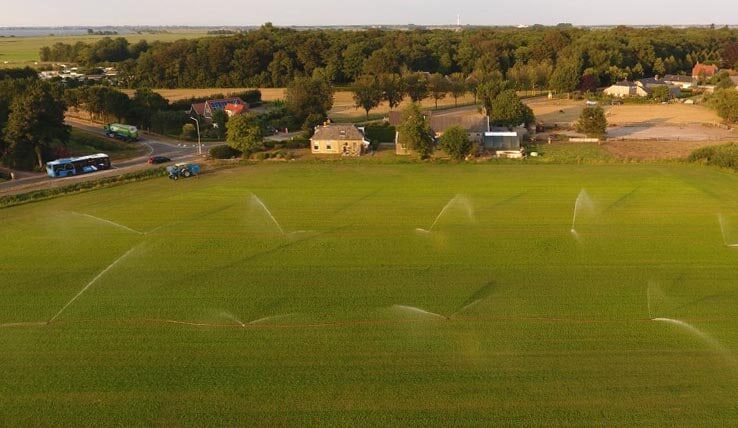
If you have already been irrigating during a drought, keep going. If the grass has turned quite yellow and you haven't started yet, don't start now: the grass is dormant and grows back once there is moisture. In spring, irrigating dry sandy soil gave an average of 24 kg dry matter per mm of water (WUR).
extra grass yield per mm of irrigation in spring on dry sandy soil; on grazed fields there was no clear effect
WUR, calculation De MarkeThe grass is yellow, your silage stocks are shrinking and there is no rain in the forecast. Now you have to choose: irrigate or wait. That depends on what you have already done and on how much rain is still to come. It also decides your next cut and your silage stocks.
That depends on what you have already done:
Calculations by Wageningen University & Research (WUR) for the De Marke research farm show that irrigating grass in spring on dry sandy soil gives an average of 24 kg dry matter per mm of water. On grazed fields there was no clear effect.
Usually not. In a drought, grass curls up and turns yellow, and it soon looks dead. But the plant is dormant. As long as the growing point is alive, the grass grows back. That only happens once there is enough moisture again.
One or two showers aren't enough. It has to rain properly for several days in a row before the grass recovers and starts growing. The weather stays changeable: the big question is whether it will rain and how much. That is why we outline three scenarios below.
If no rain falls in the coming weeks and a wet spell only arrives in early September, you won't bring in the next cut until late September or early October. The rain may also come too late for your fields. By then autumn is close, and after two weeks of rain the grassland is too wet. You can then forget about the last cut.
What does that mean for you?
If small showers fall, you have to wait and see what effect they have. That depends on the condition of your grassland and the soil type.
If it rains properly for several days in a row, the grass gets going again. After that it takes about 3 to 4 weeks before you can cut again.
In this scenario, the damage is limited for many farmers. Hardly anything needs reseeding. Many farmers don't need to buy in feed either, because they still have stocks from last year.
After a dry spell, every cut is valuable. Dry grass is harder to ensile. What dry silage means and how to deal with it is explained in a separate article, as are the 6 tips for good silage compaction. What else decides the quality of your silage is covered in improving silage quality.
After that, you seal the silage properly: this is how covering grass silage works. See how to cover your grass silage airtight with Silage Safe, without tyres, on our product information page. If you also grow maize, see when to irrigate maize.
Not sure about your silage?
We are happy to help.
That depends on how much rain comes and what state your fields are in. If the rain stays away for a long time, look at which fields you will reseed. If heavy rain comes soon, it is often not necessary.
Usually, yes. Yellow grass is often dormant, not dead. As long as the growing point is alive, it grows back as soon as there is enough moisture again.
Updated on 5 November 2026.