
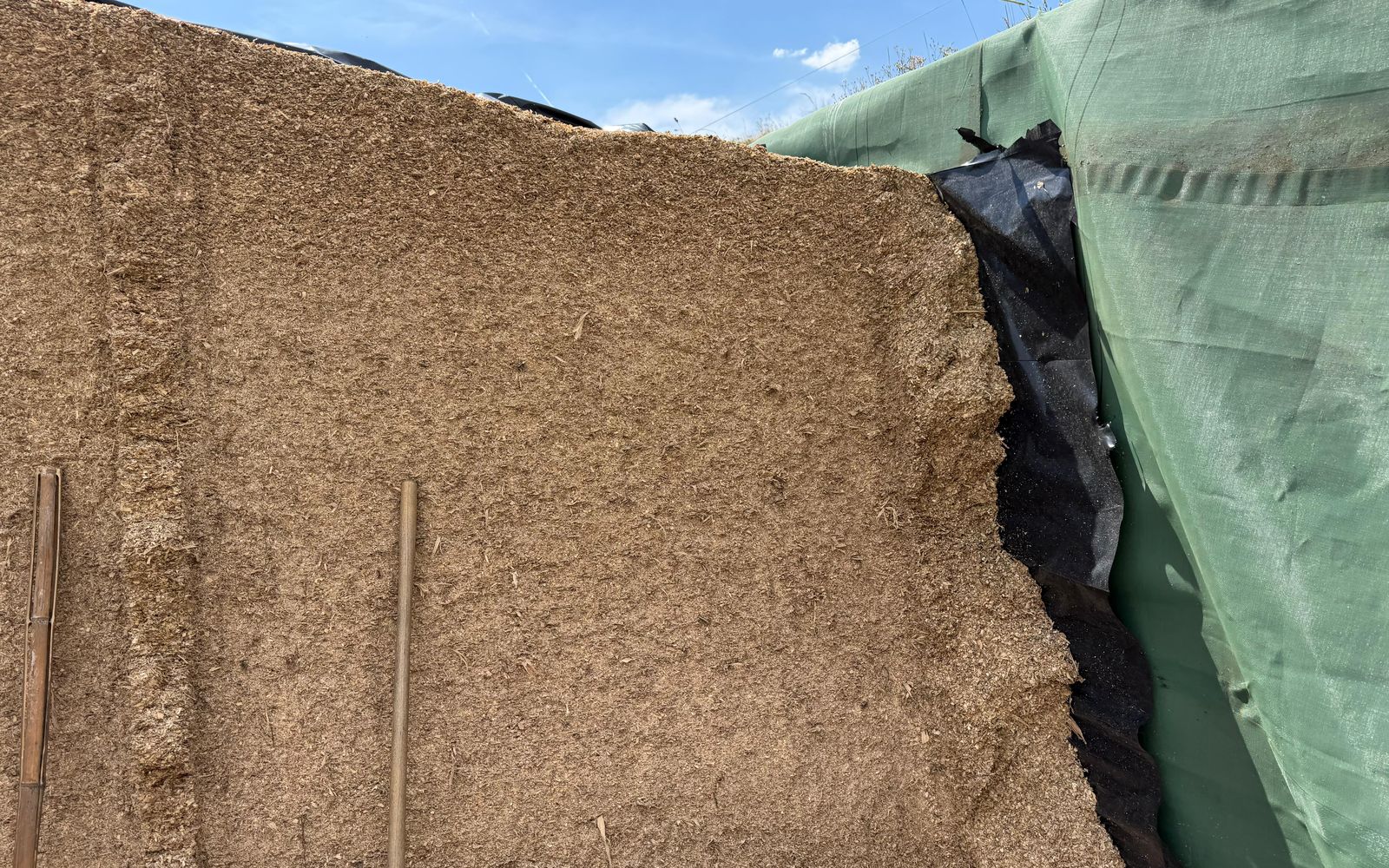
Dry silage is hard to compact, so more air stays in the pit. Eurofins Agro calls silage with more than 50% dry matter too dry. Fermentation then starts later and the risk of heating is higher. Have the crop chopped, cover quickly and airtight, and raise your feed-out rate.
Part of the guideMaking and preserving silage: the complete guide
dry matter: above this level silage is too dry and hard to compact
Eurofins Agrodry matter: the ideal crop for compacting
Groeikracht, VeeteeltGRAS March 2025Dry silage heats up faster, and your cows often eat less of it. The feed value is also likely to be lower. With a few steps at ensiling and feeding out, you can still get the best possible feed from it.
Eurofins Agro calls silage with more than 50% dry matter too dry: it is hard to compact. According to an infographic by Groeikracht, a Dutch silage advisory group, the ideal crop for compacting has between 35 and 45% dry matter. Not sure? Have a silage analysis done.
A dry crop doesn't compact as well, so the silage is less dense. More oxygen stays in the feed. That means it takes longer for fermentation to start.
If the crop is also stemmy, it probably contains less sugar. Its woodier structure also makes it harder for the bacteria to reach the sugars. That slows down fermentation too. How fermentation works and which pH suits your dry matter is explained in silage pH and fermentation.
Dry silage is looser, so it holds more air. After opening, oxygen also gets further into the pit from the silage face. Yeasts then become active sooner. On top of that, dry silage forms fewer acids, which also makes it more sensitive to heating (Eurofins Agro). What you can do about heating is covered in preventing silage heating.
Drought often starts in the field. What you can do then is explained in drought on grassland.
 From the farm
“When I open the silo, I notice that the quality of the feed is really excellent.”Hermann TenBerge, Gronau (Germany) · read the story
Not sure about your silage?
We are happy to help.
The feed feels loose and stemmy and springs back when you press on it. You only know for sure with a silage analysis, which measures the dry matter content.
According to Groeikracht, a crop with 35 to 45% dry matter compacts best. Above 50%, Eurofins Agro calls silage too dry. Note: drier grass silage can have a higher pH. At 35% dry matter a pH of up to about 4.6 is still good, at 45% up to about 5.0 and at 50% up to about 5.2 (WUR dairy farming handbook).
Not always, according to Eurofins Agro. If the material is too dry, you won't get a good pH even with an additive.
Updated on 5 November 2026.
 Ensiling & compactionQuestions & answers
After you seal the pit, the crop and micro-organisms first use up the last oxygen. Then lactic acid bacteria turn sugars into…
Grass · Maize6 min read Ensiling & compactionGuide
You make silage by storing grass or maize without oxygen, so lactic acid bacteria can ferment it. Work cleanly, ensile at the…
Grass · Maize8 min read Ensiling & compactionTips
During silage fermentation, lactic acid bacteria turn sugars into acids, which makes the pH drop. Wet grass silage is good at a…
Grass · Maize4 min read