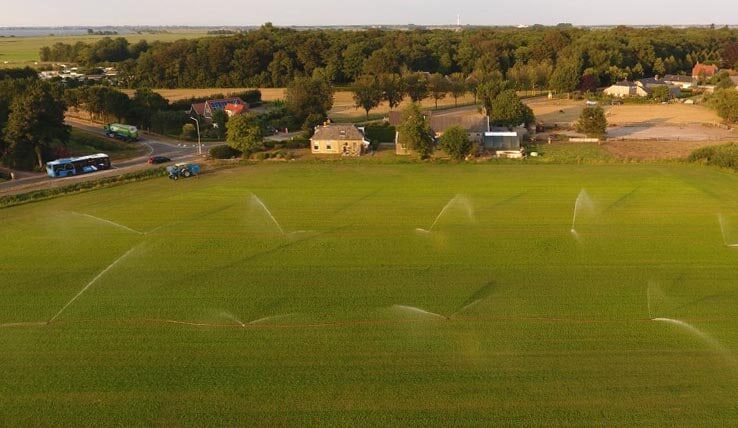
Growth stage decides when to irrigate maize. It pays off most just before and during flowering, when drought means poor grain set and less starch. Irrigate when the leaves curl during the day and stay curled the next morning. On dry sandy soil, WUR calculations give forage maize on average 38 kg dry matter per mm of water (De Marke).
extra yield per mm of irrigation for forage maize on dry sandy soil, clearly more than for grass
WUR, calculation De MarkeIt has been dry for weeks and the maize leaves are curling. Even so, you don't have to start irrigating straight away. Maize uses water sparingly and can cope well with a dry spell early on. Around flowering it is a different story: a water shortage then costs you starch and feed value.
Not as much as you might think. In spring, maize can often develop well. Even so, soil moisture runs short in many areas during dry periods. And even when the crop shows signs of drought, irrigating isn't always necessary. Maize uses water very efficiently: per kilo of dry matter, maize needs clearly less water than grass.
Look at the leaves. Are they curled during the day and still curled the next morning? Then the plant really is short of water. If the leaves only curl in the heat of the day and open up again in the morning, the plant is still coping.
Walk your fields now and then and look at what the plants need, especially in warm spells.
Just before and during flowering. A water shortage then causes the biggest loss. If there is too little water around flowering, you get poor grain set (WUR, Handboek Snijmaïs). That costs starch yield, and the feed value of your silage will be lower. That is what you want to avoid. What else you can do for a good maize harvest is explained in improving maize silage quality.
Calculations by Wageningen University & Research (WUR) for the De Marke research farm show that irrigating forage maize on dry sandy soil gives an average of 38 kg dry matter per mm of water, clearly more than for grass.
During leaf and stem development, the crop doesn't need much water yet. If water is short, the plant goes looking for it and roots deeper. At this stage, irrigating gives little return.
Don't act too quickly either. Irrigating too early means the roots don't go deep, and that causes problems later on.
Yes. Sandy soil needs irrigating sooner than heavy clay or peat. But be careful with clay soil: don't let it get too dry. If deep cracks form in the field, repairing them is a much bigger job.
Once the maize is harvested, storage begins: covering maize silage properly and making sure of good silage fermentation. See how to cover your silage airtight with Silage Safe on our product information page. If your maize was harvested dry, the article on dry silage and its effects will help.
Your grassland feels the drought too. See drought on grassland: irrigate or wait?.
Not sure about your silage?
We are happy to help.
Hardly. During the leaf and stem stage the crop needs little water, and in dry conditions the plant roots deeper. Irrigating too early means the roots don't go deep.
Not always. Check whether the leaves are still curled the next morning. Only then is the plant really short of water.
Sandy soil needs irrigating sooner than heavy clay or peat. But don't let clay get too dry: deep cracks in the field are hard to repair.
Updated on 5 November 2026.