
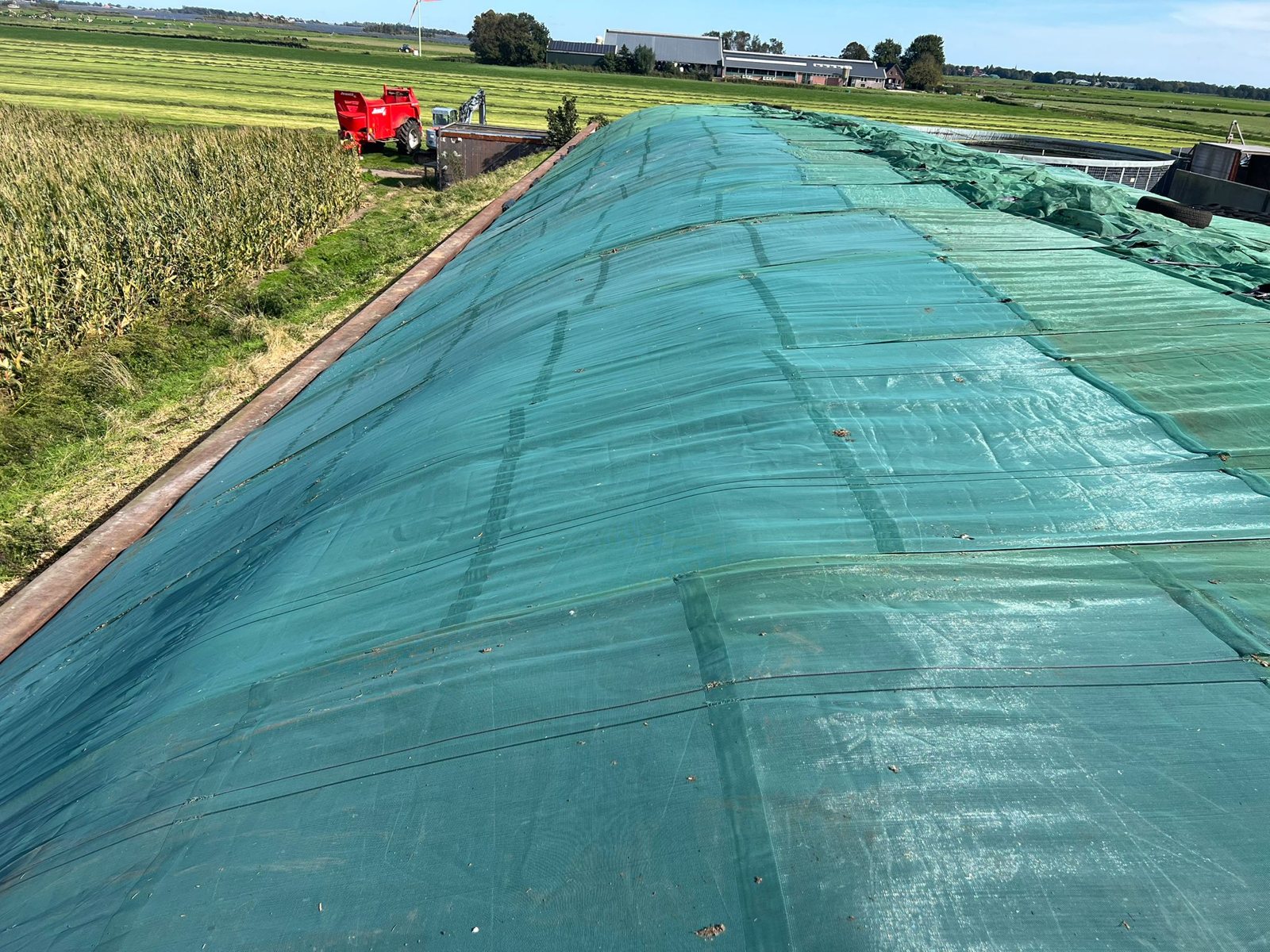
Cover maize silage straight after rolling, with underlay film over the full width, a new top sheet and side-wall plastic along the walls. Harvest maize at 32-36% dry matter (WUR maize handbook), chop at 6-8 mm, roll evenly and finish the top smooth and slightly rounded. Keep the pit closed for at least 4 weeks (WUR), preferably 6.
dry matter to aim for when ensiling forage maize; above 36% the risk of heating increases
WUR, Handboek Snijmaïs 2019chop length at which maize compacts well and quickly
WUR, Handboek Snijmaïs 2019minimum feed-out rate per week in summer, 1.5 metres in winter
Silage SafeMaize silage that heats up at the face costs you feed and milk. Maize ferments easily, but maize silage is sensitive to heating. Every mistake at harvest, rolling and covering shows up later at the silage face.
First choose a maize variety that suits your soil and your region. Some varieties do better on sandy soils, others on clay, and not every variety ripens equally early. Talk to your seed supplier or crop adviser.
Harvest the maize when it has 32-36% dry matter. That is the advice in the maize handbook of Wageningen University & Research (WUR). Above 32% there are no more effluent losses, and above 36% the risk of heating and mould during feeding increases. Maize that is too wet ferments more slowly. Maize that is too dry is hard to compact, holds more air and heats up faster. There is also a lot you can do before harvest: see improving maize silage quality.
The full step-by-step plan for covering is in the guide covering a silage pit.
A large maize silage pit can also be covered without heavy lifting. At Jennissen in Den Dungen (NL), a 90 x 14 x 4 metre maize silage pit is covered with Silage Safe. They used to spend an hour every week shovelling soil off the pit. Now they open it in five minutes. "We're saving a lot of time and no longer have problems with heating."
Good maize silage usually has a pH of 4.0 to 4.2 (WUR maize handbook). Rainwater is much less acidic than good silage. If it runs into the silage, the pH rises in that spot and moulds and bacteria get a chance. You often see this at the bottom and along the walls. Make sure there is good drainage in and around the pit and let the water run out along the wall.
See how the drainage in the bottom hem of the covers works on our product information page. What else you can do about rainwater in silage is in a separate article.
Maize contains a lot of sugar and starch. Yeasts live on them as soon as oxygen gets in after opening. The drier the maize, the greater the risk: according to the WUR maize handbook, above 36% dry matter the risk of heating and mould during feeding increases. Good rolling, covering straight away and a high enough feed-out rate help. All tips are in preventing silage heating.
 From the farm
“This is the best silage I’ve ever seen.”Rathkennery Farm, Tullykeel (Ireland) · read the story
Not sure about your silage?
We are happy to help.
6 to 8 mm (WUR maize handbook). That compacts well. If the maize is drier, chop on the short side, so you can still compact it well.
At least 4 weeks (WUR maize handbook), preferably 6. By then the pH has dropped far enough and the maize stays stable when you open the pit.
Yes. A covering system with covers and straps holds the plastic in place and gives pressure on the edges, without you having to haul tyres.
Updated on 5 November 2026.
 Covering & protectingProblem & solution
If the plastic blows loose in a storm, put it back quickly and hold it down with weight or covers, starting on…
Grass · Maize5 min read Covering & protectingTips
Prepare your silage pit well before ensiling. Clean and dry the pit and the access route, mow around it and make sure…
Grass · Maize6 min read Covering & protectingTips
You prevent pests at your silage pit by taking away food, water and hiding places. Clear up silage residue straight away, mow…
Grass · Maize4 min read