
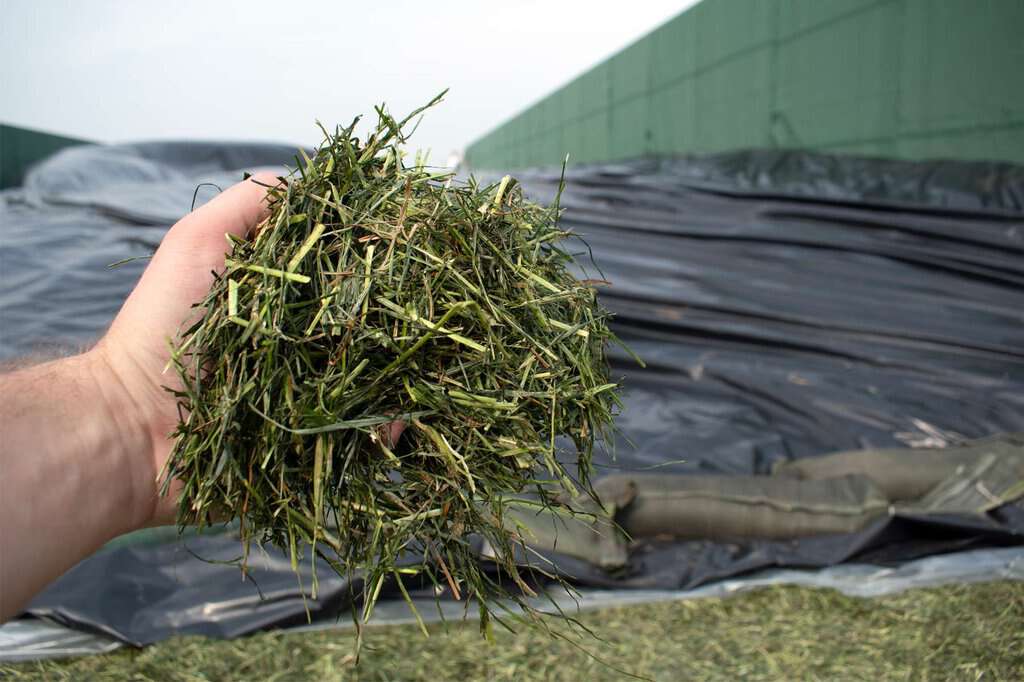
The sugar content of grass decides how well your grass silage ferments: bacteria turn sugar into lactic acid and acetic acid. Sugar content rises during the day. Between morning and evening the difference can be 35 to 50 grams of sugar in the fresh crop (WUR). So after sunny days, mow later in the day and seal quickly.
Part of the guideMaking and preserving silage: the complete guide
difference in sugar in fresh grass between morning and evening
WURdry matter that grass can wilt to by evening if you mow in the middle of the day
WURSugar in grass is the fuel for your grass silage. If there is too little, the silage ferments poorly and the feed is less palatable. How much sugar you get into the pit depends largely on the weather, the moment you mow and how quickly you seal.
During preservation, bacteria turn the sugars in the grass into lactic acid and acetic acid. These acids make the pH of the silage drop. That gives unwanted bacteria, moulds and yeasts less chance and keeps the feed good. Together with the remaining sugars, the acids also make the feed palatable for your cows. How this works exactly is in silage pH and fermentation.
Sugar content rises during the day, especially in sunny weather. The difference between morning and evening can be 35 to 50 grams of sugar in the fresh crop (WUR). So it is better to mow later in the day than early in the morning. WUR advises mowing in the middle of the day, once the dew is off. Then the grass can still wilt to about 30% dry matter by evening, and less is lost overnight.
With little sugar, the bacteria form less lactic acid and acetic acid. The silage then ferments more slowly and less well. The feed preserves worse and is less palatable. Cows eat less of it, and that costs production. Silage that doesn't ferment well also gives butyric acid bacteria more chance.
Sugar and protein often move in opposite directions. Silage analyses show that one summer gives a high sugar content with little protein, while in another period fresh grass has a lot of protein and little sugar. That depends on the weather and on fertilising:
What you keep in the pit, you will see in what your cows eat. "We can now retain much more of the protein in our grass silage," says Jarne Schuiling from Vries.
Keep in mind: the sugar content of fresh grass doesn't tell you everything about the silage. How quickly the grass wilts and how quickly the silage starts to ferment decide how much sugar really ends up as lactic acid. More tips for spring are in first cut silage tips, and the whole chain from soil to covering is in improving silage quality.
 From the farm
“When I open the silo, I notice that the quality of the feed is really excellent.”Hermann TenBerge, Gronau (Germany) · read the story
Not sure about your silage?
We are happy to help.
With a refractometer (Brix meter) you measure the dissolved solids in a drop of grass juice. That gives an indication. It isn't an exact sugar measurement, because other dissolved substances count too. If you want to know exactly, have a grass or silage analysis done.
With a lot of nitrogen from the soil or from fertiliser, protein rises and sugar falls. Little sun and warm nights also lower the sugar content.
As quickly as the dry matter content allows. WUR says ensiling before the next evening is ideal. Every extra day in the field costs sugar.
Updated on 5 November 2026.
 Ensiling & compactionQuestions & answers
After you seal the pit, the crop and micro-organisms first use up the last oxygen. Then lactic acid bacteria turn sugars into…
Grass · Maize6 min read Ensiling & compactionGuide
You make silage by storing grass or maize without oxygen, so lactic acid bacteria can ferment it. Work cleanly, ensile at the…
Grass · Maize8 min read Ensiling & compactionTips
During silage fermentation, lactic acid bacteria turn sugars into acids, which makes the pH drop. Wet grass silage is good at a…
Grass · Maize4 min read