
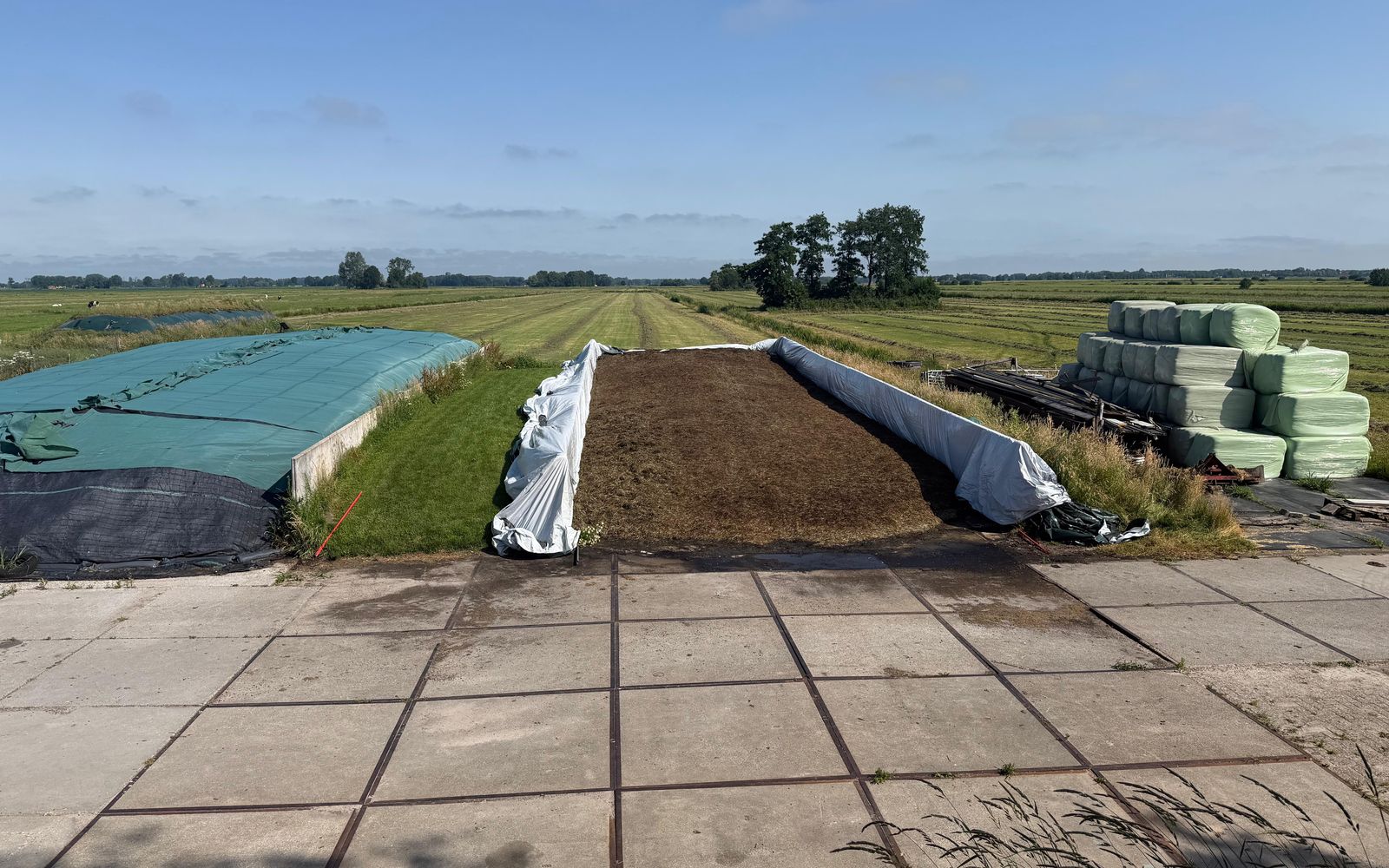
After you seal the pit, the crop and micro-organisms first use up the last oxygen. Then lactic acid bacteria turn sugars into lactic acid and the pH drops. After at least 6 weeks the silage is stable. Every hour the pit stays open after rolling costs about 1.5% dry matter (Groeikracht, Veeteelt 2021).
Part of the guideMaking and preserving silage: the complete guide
the first hours after ensiling decide how quickly the oxygen is gone and fermentation starts
Silage Safedry matter lost for every hour the pit stays open after rolling (field trial with bales)
Groeikracht, Veeteelt May 2021minimum time before the silage is stable and the pit can be opened
Silage SafeThe pit is sealed, but the real work inside the silage is only just starting. Making silage means storing feed without air. Bacteria do the work, as long as you get the conditions right. What goes wrong in the first hours and weeks shows up months later at the feed barrier.
Silage is forage stored with as little oxygen as possible, so that fermentation preserves the feed. The process has four phases:
The faster the pit is free of oxygen, the more feed value you keep. That makes the first 24 to 48 hours after ensiling the most important. The whole chain from mowing to feeding is in the guide making and preserving silage.
Oxygen is the switch that starts heating. As soon as oxygen reaches the feed, yeasts become active. They break down sugars and lactic acid and turn them into heat. As the lactic acid disappears, the pH rises. Then moulds get a chance too, and they can produce mycotoxins.
The longer the pit stays open, the longer the oxygen phase lasts and the later fermentation starts. In a field trial with bales by Groeikracht, a Dutch silage advisory group, every hour of waiting before sealing cost about 1.5% extra dry matter. After 2.5 hours, more than 6% of the dry matter was lost (Veeteelt, May 2021). So cover the pit as soon as it is full. How to do that for each crop is in covering grass silage.
Oxygen gets in at three moments:
Rainwater also disturbs the preservation: rainwater is much less acidic than good silage and slows down fermentation. Here is how to keep rainwater out of your silage. All tips against heating, during ensiling and feeding out, are in preventing silage heating. A covering system helps with some of these points, but no system is a miracle cure. Every step has to be right.
Grass at around 40% dry matter is a good middle ground for most farms. A higher percentage only works if the material is chopped more finely, so you can still compact it enough. Also keep in mind that a longer wilting period in the field costs feed value.
If grass is too wet (below 30-35% dry matter), the pH drops too slowly. Water has a pH of 7 and slows down fermentation. This can lead to butyric acid.
At or above 50% dry matter, the material is often stemmy. It is hard to compact enough, more oxygen stays in and fermentation is slower. The silage becomes more prone to heating.
Keep the pit closed for at least 6 weeks before you start feeding. If you open it earlier, the pH hasn't dropped far enough and the feed isn't stable. With the oxygen that gets in, yeasts and moulds can grow quickly.
The pH is one signal alongside the other figures in your silage analysis. It depends on the dry matter and the type of silage. Wet grass silage (below 25% dry matter) is good at a pH of 3.8 to 4.2, and the drier the grass silage, the higher the pH can be (WUR, Handboek Melkveehouderij). Maize silage is usually at 4.0 to 4.2 (WUR, Handboek Snijmaïs). The limits for each dry matter level are in silage pH and fermentation.
A pH that is too high can occur in silage that is too dry as well as too wet. Then also look at the aerobic stability and the acids in your silage analysis. In maize silage, a higher pH can mean that oxygen was present for too long or that less lactic acid was formed.
An example calculation from our brochure. A silage pit of 50 × 10 × 3 metres, with a small heap above the walls, holds about 1,750 m³ of grass silage. At 230 kg of dry matter per m³, that is 402,500 kg of dry matter. At a replacement value of €0.22 per kg of dry matter, that silage is worth €88,550 in feed value. Heating can easily cost an extra 10% in feed value (Silage Safe brochure, Eurofins Agro). That is €8,855. These figures are an indication only, not a guarantee. You'll find the full example in the brochure on our product information page.
 From the farm
“The great thing is that we can preserve the proteins of the grass much better this way.”Jarne Schuiling, Vries (Netherlands) · read the story
Not sure about your silage?
We are happy to help.
They turn sugars into lactic acid and other acids. This makes the pH drop and holds back unwanted bacteria, yeasts and moulds. They only work without oxygen.
Because oxygen reaches the feed. Yeasts then become active and break down sugars and lactic acid. This releases heat. That is called heating.
Ensiling is storing fresh grass, maize or another crop airtight, so that it keeps through fermentation. That way you have forage for your cows all year round.
Updated on 5 November 2026.
 Ensiling & compactionTips
During silage fermentation, lactic acid bacteria turn sugars into acids, which makes the pH drop. Wet grass silage is good at a…
Grass · Maize4 min read Ensiling & compactionTips
Roll silage in layers (grass up to 20 cm, maize 30-40 cm) with a weight of at least half the hourly intake:…
Grass · Maize3 min read Ensiling & compactionTips
You improve maize silage quality mainly at harvest and ensiling. Harvest at 32-36% dry matter (WUR, Handboek Snijmaïs), chop at 6 to…
Maize4 min read