
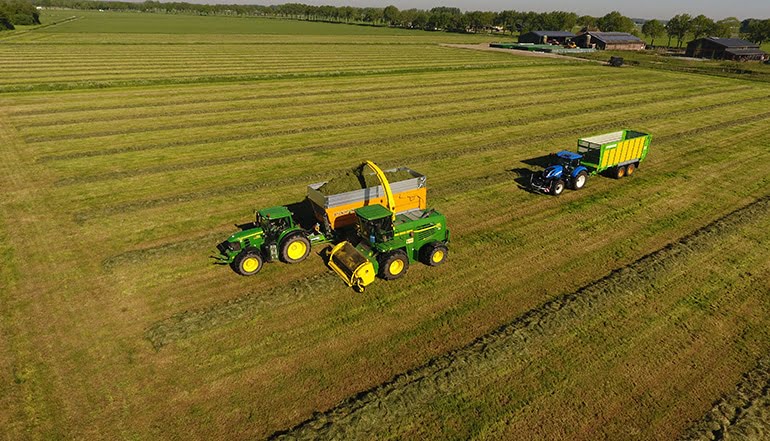
You improve silage quality in six steps: fertilise for good soil, keep a dense sward, don't cut too short, ensile in layers, compact carefully and cover tightly, especially at the edges. It pays off: about three quarters of a dairy cow's ration is forage (Koeien & Kansen, WUR, 2023).
Part of the guideMaking and preserving silage: the complete guide
of a dairy cow's ration is forage
Koeien & Kansen (WUR), 2023where the growing points of grass are: cut above this
Silage SafeYour cows eat what you put in the pit all year round. You can't control the weather, but from the soil to the cover there is a lot you can control yourself. With these 6 steps you get more quality out of your grass and maize.
About three quarters of a dairy cow's ration is forage. On the farms of Koeien & Kansen, a network run by Wageningen University & Research (WUR), this was grass silage, fresh grass and maize together in 2023; concentrates and dairy by-products made up 23%. Every step that improves quality shows up in what your cows eat and in your bulk tank. For an overview of the whole process, see the guide making and preserving silage.
Quality starts with the soil. With enough organic matter in the soil, grass grows better. Fertilising feeds the land and gives a high grass yield of good quality. If your land suffers from drought, see what you can do in drought on grassland.
A good sward is free of weeds, has good grass varieties and produces grass that is high in sugar. More sugar means more energy and better digestion for your cows. In the pit, the good bacteria can then grow better, which helps prevent heating and mould. Why sugar matters so much is explained in grass sugar content.
How to work on your sward:
If you cut your grass too short, you may get a good yield, but the next cut suffers. You cut away the growing points and the grass grows back more slowly. The growing points are at about 5 cm, so cut above that. We recommend a stubble of 6 to 7 cm (WUR gives 5 to 6 cm). Cutting higher also helps keep soil out of the feed.
A stable ration is good for your cows. One way to get it is to ensile in layers in the same pit. You put the second cut on top of the first, the third on top of that, and so on. The first cut is usually the most palatable. When feeding out, you cut through all the layers, so your cows are eating some first cut all year round. That way you feed a consistent ration.
A walled silage pit is a good way to limit heating: the feed is enclosed between the walls. But the rolling has to be done well. Many farmers and contractors give it too little attention.
More tips are in silage compaction tips. For maize, you will find specific tips in improving maize silage quality.
Covering is the last step to hold on to your quality. The edges and the top layer are the weak spots of a silage pit. That is where the risk of heating and mould is highest. Roll the silage evenly, finish the top smooth and slightly rounded so no water stays on it (WUR), and make sure the cover is tight along the sides too. With Silage Safe you make the silage rounded, so the covers pull the plastic tight over the whole pit and water runs off through the drainage. How to do this step by step is explained in covering a silage pit. See how Silage Safe tensions the covers towards each other on our product information page. "When it comes out from under there, it's just better silage," says Sybren Nauta from Itens about his silage under Silage Safe.
A forage or silage analysis shows you in black and white how your silage has turned out. It gives you the dry matter, the feed value and the pH, among other things. Two figures from Eurofins Agro tell you a lot about your ensiling work:
That way, every cut teaches you what to do differently next time.
 From the farm
“When I open the silo, I notice that the quality of the feed is really excellent.”Hermann TenBerge, Gronau (Germany) · read the story
Not sure about your silage?
We are happy to help.
Not below the growing points, which are at about 5 cm. We recommend a stubble of 6 to 7 cm. If you cut shorter, the grass grows back more slowly. Cutting higher also keeps soil and dirt out of your silage.
Keep the layers thin. A thick layer is stiff and doesn't compact well, so air stays in the silage.
Silage where you put several cuts on top of each other in the same pit: the second cut on the first, the third on top of that. When feeding out, you always feed a mix of all the cuts, so the ration stays consistent.
Updated on 5 November 2026.
 Ensiling & compactionQuestions & answers
After you seal the pit, the crop and micro-organisms first use up the last oxygen. Then lactic acid bacteria turn sugars into…
Grass · Maize6 min read Ensiling & compactionGuide
You make silage by storing grass or maize without oxygen, so lactic acid bacteria can ferment it. Work cleanly, ensile at the…
Grass · Maize8 min read Ensiling & compactionTips
During silage fermentation, lactic acid bacteria turn sugars into acids, which makes the pH drop. Wet grass silage is good at a…
Grass · Maize4 min read