
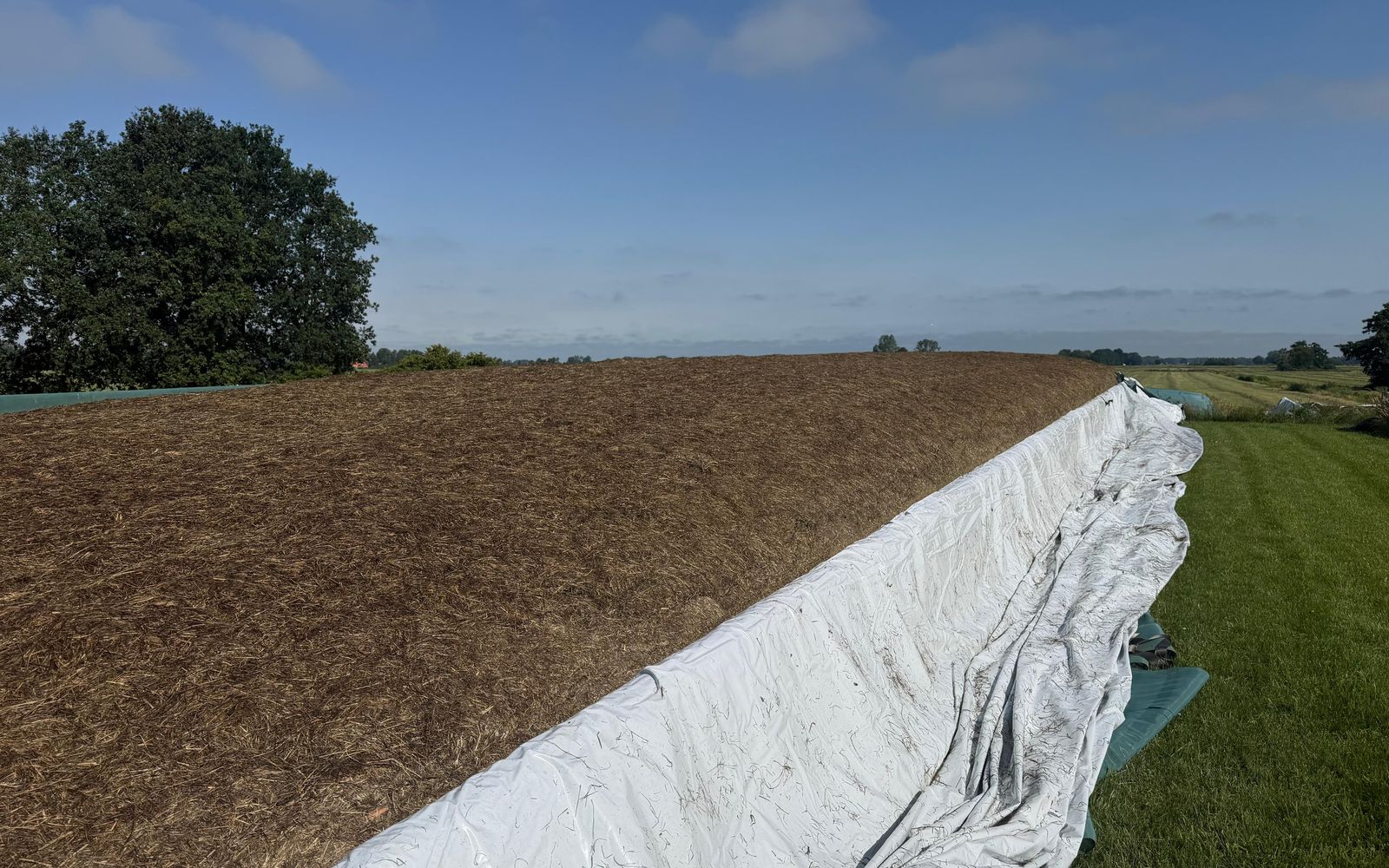
During silage fermentation, lactic acid bacteria turn sugars into acids, which makes the pH drop. Wet grass silage is good at a pH of 3.8 to 4.2. The drier the grass silage, the higher the pH can be: up to about 5.0 at 45% dry matter (WUR). Good compaction, sealing straight away and keeping water out all help fermentation.
Part of the guideMaking and preserving silage: the complete guide
good pH for wet grass silage (below 25% dry matter); drier grass silage can be higher
WUR Handboek Melkveehouderijusual pH of maize silage
WUR Handboek Snijmaïsdry matter lost if you only seal the pit after 5 hours (field trial with bales)
Groeikracht, Veeteelt May 2021If your silage ferments too slowly, moulds and bacteria get a chance. If the pH drops quickly and stays stable, your silage keeps well. That way you prevent heating and loss of feed value, and you save on feed costs.
Once the pit is sealed and the last oxygen has gone, lactic acid bacteria turn sugars into acids, such as lactic acid, acetic acid and propionic acid. This makes the pH drop. That low pH holds back bacteria and yeasts, and that is how the feed is preserved. Well-fermented silage is also more palatable, so cows eat more of it.
Lactic acid bacteria need an environment without oxygen for this: an airtight pit. If conditions aren't right, unwanted bacteria such as butyric acid bacteria get a chance, and heating is just around the corner. More about butyric acid in silage. All phases after ensiling are in what happens in your silage after ensiling.
That depends on the dry matter. The drier the grass silage, the higher the pH can be. These are the limits for well-made silage (WUR, Handboek Melkveehouderij):
Maize has its own range: normal maize silage is usually at 4.0 to 4.2 (WUR, Handboek Snijmaïs).
In the silage analysis from Eurofins Agro, the preservation index shows how preservation has gone. The index runs from 0 to 100, and the target is above 80.
See how Silage Safe seals your pit quickly and tightly on our product information page.
Maize contains more sugars. Bacteria quickly turn them into acids, so the pH drops faster. With grass, a lot depends on the sugar content at the moment of mowing. Why that is so is in sugar content of grass.
 From the farm
“The great thing is that we can preserve the proteins of the grass much better this way.”Jarne Schuiling, Vries (Netherlands) · read the story
Not sure about your silage?
We are happy to help.
According to Eurofins Agro, an additive is only needed if conditions at ensiling aren't right. If the grass is too dry, you won't get a good pH even with an additive.
With a silage analysis. It shows the pH, the dry matter and the preservation index, so you can see whether the pH fits the dry matter of your silage.
Rainwater is much less acidic than good silage. If it runs into the feed, the pH rises in that spot and yeasts and moulds get a chance. Here is how to keep rainwater out of your silage.
Updated on 5 November 2026.
 Ensiling & compactionQuestions & answers
After you seal the pit, the crop and micro-organisms first use up the last oxygen. Then lactic acid bacteria turn sugars into…
Grass · Maize6 min read Ensiling & compactionGuide
You make silage by storing grass or maize without oxygen, so lactic acid bacteria can ferment it. Work cleanly, ensile at the…
Grass · Maize8 min read Ensiling & compactionTips
Roll silage in layers (grass up to 20 cm, maize 30-40 cm) with a weight of at least half the hourly intake:…
Grass · Maize3 min read