You calculate silage losses from the volume of your pit, the dry matter per m³ and the value per kilo of dry matter. A 50 x 10 x 3 metre pit holds about €88,550 of feed value. With a 10% loss through heating (Silage Safe brochure, Eurofins Agro), that is €8,855 per year. Indicative figures only.
additional feed value can easily be lost through heating
Silage Safe, brochure 2026 (Eurofins Agro)of the feed value can be lost through heating
WUR, Handboek Melkveehouderijfeed value per year at 10% loss in a 50 x 10 x 3 metre pit (indicative)
Silage SafeYou fertilised well, the weather played along and ensiling went without a hitch. Even so, your crop is only safe once it is at the feed barrier. Of every tonne of dry matter from grass or maize, part is lost along the way. With a few measurements of your own silage pit, you can work out what that costs.
Feed is lost at three stages:
The tricky part: you hardly see these losses. The silage doesn't visibly shrink, and you can't read the feed value from the outside. That is why it helps to put a figure on it.
Heating can easily cost an additional 10% of feed value (Silage Safe, brochure 2026, based on Eurofins Agro). According to Wageningen University & Research (WUR), up to 17% of the feed value can be lost through heating. Heating usually starts at the edges, in the top layer and at the silage face: that is where air reaches the silage most easily. Rainwater running in along the wall makes it worse. How to prevent this is explained in preventing heating in silage and keeping rainwater out of your silage.
We use a silage pit 50 metres long, 10 metres wide and 3 metres high.
These figures are for illustration only and depend on silage quality, feed value and current prices.
You need four figures. Get your calculator out and fill in your own values.
Using a calculator for your feed-out rate as well? Those often work in kilos of fresh silage per m³, so the silage as it comes out of the pit. The 230 kg per m³ in this example is dry matter. You can't use those two figures interchangeably.
If you ensile several times a year in the same pit, for example when adding another cut on top of the existing silage, calculate per layer and add up the amounts.
Set the loss against what a cover costs you. A Silage Safe system lasts around 10 years, so spread the purchase price over 10 years and compare that annual cost with the feed value you would otherwise lose: €8,855 per year in the example.
The price depends on factors such as the dimensions of your pit, the maximum silage height, the system configuration and transport. Want to know what it costs for your pit? Request a quote.
Henry Molenaar of HyCare dairy farm De Bladelse Hoef in Bladel used to cover his silage pits with soil. Since he started working with Silage Safe: "We're losing a lot less feed value now."
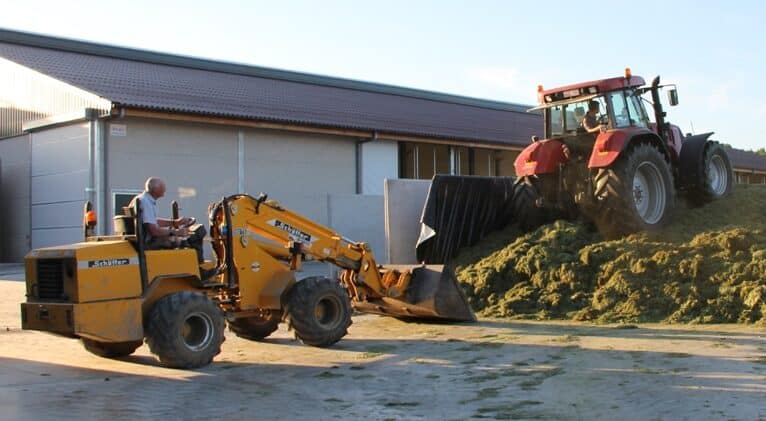
The pit itself is often where most is lost, so that is also where there is most to gain:
Not sure about your silage?
We are happy to help.
Multiply the volume of your silage (length x width x height) by the kilos of dry matter per m³. This density varies from pit to pit. Your feed adviser or a silage analysis will give you a reliable figure.
No. They depend on the weather during ensiling, the dry matter, how well you compact and cover, and how fast you feed out. So calculate with a few percentages, for example 5%, 10% and 15%.
In the brochure we also convert the example into milk. Based on the energy value of the silage, the pit in the example is good for about 805,000 kg of milk. At a 10% loss, that is 80,500 kg of milk, and at a milk price of €0.50 per kg, €40,250 of potential milk production. It is the same loss, expressed in milk instead of feed value. Indicative figures only.
Updated on 5 November 2026.
We use technologies such as cookies to store and/or access information on your device. We do this to give you the best experience and to show personalised and non-personalised ads. If you consent to these technologies, we may process data such as browsing behaviour or unique IDs on this site. Not consenting or withdrawing consent may affect certain features and functions.
