
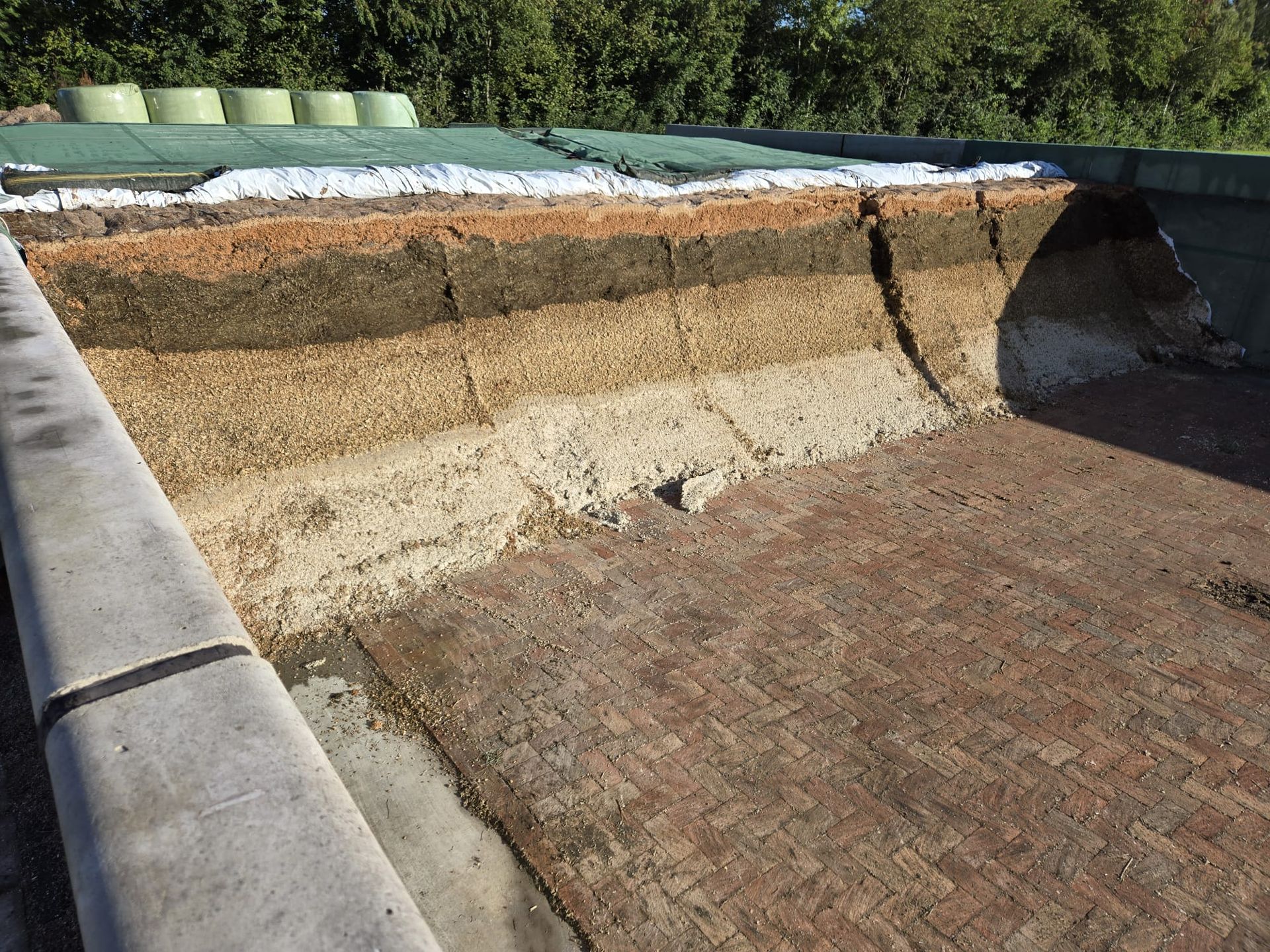
Heating in silage starts when oxygen reaches the feed and yeasts become active again. The silage warms up and loses feed value: easily an extra 10% (Silage Safe brochure, Eurofins Agro). It usually starts at the edges, the top and the silage face. Prevent it with good compaction, airtight covering straight away, no rainwater and a high enough feed-out rate.
warmer than the outside air: then the silage is heating
Eurofins Agroextra feed value is easily lost through heating
Silage Safe, brochure 2026 (Eurofins Agro)of the energy value can be lost through heating
WUR, Handboek MelkveehouderijYou open the pit and the silage along the wall is warm and musty. That is heating, and it costs you feed value, intake, milk and a lot of extra hassle. It usually starts at the edges, at the top or at the silage face. With good compaction, covering straight away and a high enough feed-out rate, you give heating little chance, in grass silage and in maize silage.
Heating is the warming up of your silage after oxygen has got in. Silage is heating when it is more than 10 °C warmer than the outside air (Eurofins Agro). The warmth quickly gives moulds and bacteria a chance. That is why heating and mould often go together. Where mould comes from is explained in 4 causes of mould in silage.
After ensiling, the pH of your silage drops because lactic acid bacteria turn sugars into lactic acid. As long as no air gets in, the silage stays stable. If oxygen does get in, for example after opening or through a hole in the plastic, yeasts become active again. They break down lactic acid and produce heat.
This happens first at the edges and at the top. Along the walls and in the top layer, the silage is hardest to compact well. So that is where most of the air is. Tyres and soil don't stay in place well at the edges. And rainwater that runs into the silage along the sides raises the pH there. Yeasts and moulds then survive, and as soon as oxygen reaches the silage again, it starts heating. With good covering and drainage you keep rainwater out of your silage.
Wiljan Ten Hove from Kamperveen in the Netherlands knows all about it. Heating and mould regularly appeared along the walls of his pits. Since he started covering his five pits with Silage Safe, he has hardly had any trouble with it.
Heating silage feels warm at the silage face. On cold mornings you sometimes see steam. You see patches of white or blue-green mould and you smell a musty or sour odour. Cows are less keen to eat it. If you want to be sure, measure the temperature half a metre behind the silage face and compare it with the outside air. If the difference is more than 10 °C, your silage is heating.
An example from our brochure: a pit of 50 x 10 x 3 metres holds about 402,500 kg of dry matter, worth around €88,550 in feed value. If 10% of that is lost, that is €8,855 per year. These figures are an indication only, not a guarantee. How to work this out for your own pit is explained in calculating silage losses.
In the morning, for example. Ensiled feed loses its heat only slowly and determines the temperature in the pit for a long time.
Grass that is too dry (above 45%) is hard to compact and holds more air. Grass that is too wet (below 35%) slows down fermentation (Groeikracht, VeeteeltGRAS March 2025). For forage maize, 32-36% dry matter at harvest is a good target. Above 36%, the risk of heating and mould during feeding out increases (WUR, Handboek Snijmaïs).
Good compaction reduces the amount of air in the pit, and air penetrates less far when you feed out. How to go about it: 6 tips for good silage compaction.
Dry or stemmy material goes at the bottom. There it is least exposed to air and well pressed down by the layers above.
Then fermentation starts straight away. In a field trial with bales by Groeikracht, a Dutch silage advisory group, the dry matter loss was more than 6% when the feed was only sealed after 2.5 hours. After 5 hours it was almost 10%, and the feed had a clearly lower feed value than feed that was sealed straight away (Veeteelt, May 2021).
Heating starts at the edges, so that is where the cover must fit tightly and apply pressure. Check regularly after ensiling for holes, for example from pests. The method is explained step by step in covering a silage pit.
At least 1.5 metres per week in winter and at least 2 metres per week in summer. More on this in the right feed-out rate.
Maize silage is known to be prone to heating. After opening, the feed contains a lot of sugars and starch that yeasts live on. The drier the maize at ensiling, the greater the risk: above 36% dry matter, the risk of heating and mould during feeding out increases (WUR, Handboek Snijmaïs). Good compaction, a tight silage face and a high enough feed-out rate help.
The Jennissen family from Den Dungen in the Netherlands covers a maize silage pit of 90 x 14 x 4 metres with Silage Safe. They say: "We're saving a lot of time and no longer have problems with heating." By keeping the surface nicely rounded and the cover tight, there's very little risk of heating. See how the covers keep pressure on the edges on our product information page.
 From the farm
“The great thing is that we can preserve the proteins of the grass much better this way.”Jarne Schuiling, Vries (Netherlands) · read the story
Not sure about your silage?
We are happy to help.
That depends on the silage and the weather. In warm weather and with a loose silage face it happens faster. That is why you keep a higher feed-out rate in summer than in winter.
Always remove mouldy feed. If you are unsure about the rest, talk to your feed adviser or have a silage analysis done.
When the silage is more than 10 °C warmer than the outside air (Eurofins Agro).
Updated on 5 November 2026.
 Heating & mouldTips
Butyric acid bacteria (clostridia) make butyric acid from lactic acid, mainly in wet silage with a high pH. They come from soil,…
Grass6 min read Heating & mouldTips
Mould in silage develops when oxygen and water reach the feed. Four main causes are poor compaction, a cover that lets air…
Grass · Maize5 min read