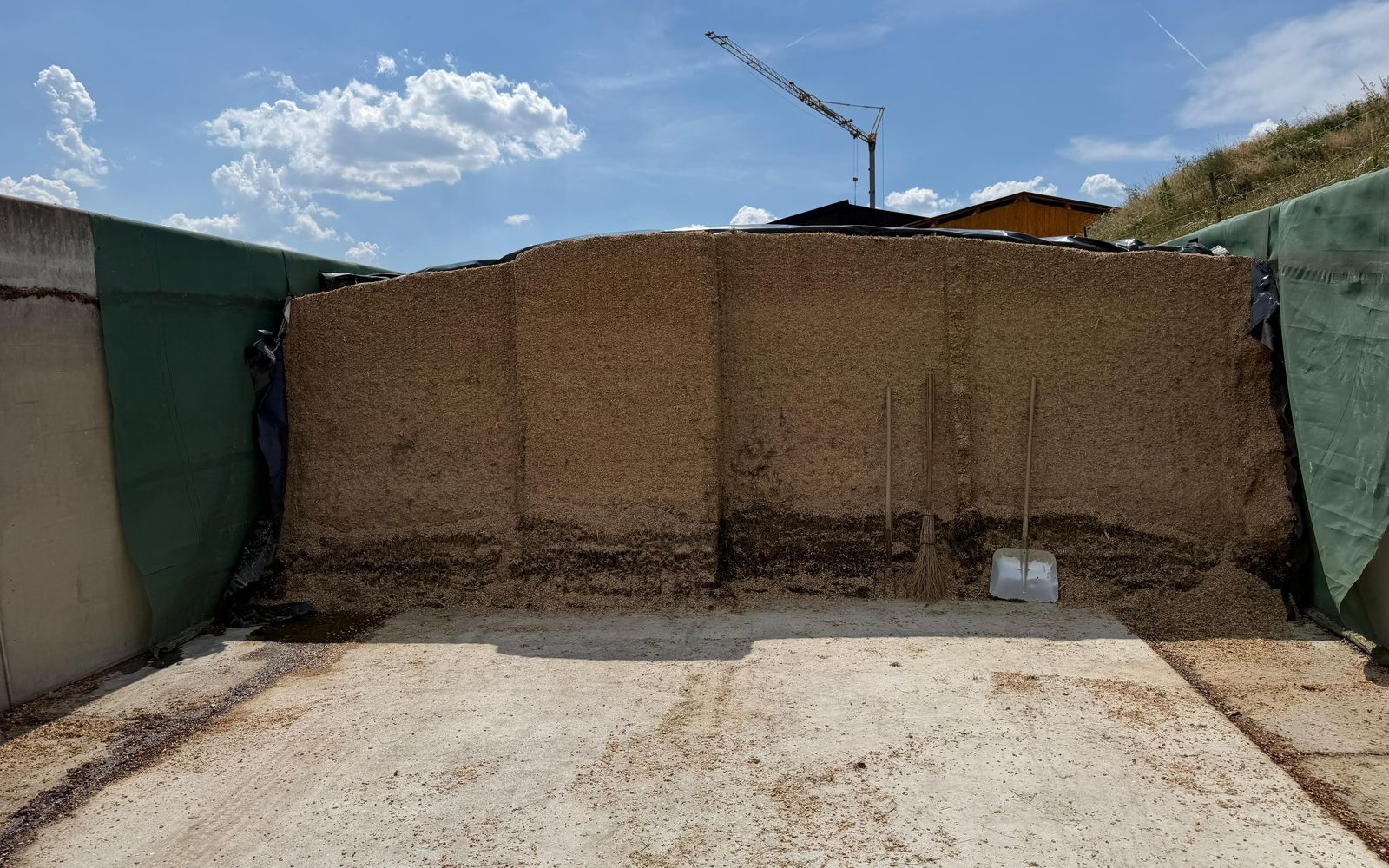
The feed-out rate of your silage pit is the number of metres you take off the silage face each week. Silage Safe recommends at least 1.5 metres a week in winter and 2 metres in summer. The faster you move through the pit, the shorter the face is exposed to air and the less chance heating and mould get.
feed-out rate per week in winter, minimum
Silage Safefeed-out rate per week in summer, minimum
Silage SafeOnce you open the pit, the silage face is exposed to air every day. If you move through the feed too slowly, it warms up and heating and mould get a chance. A steady feed-out rate is one of the simplest ways to keep your silage in good condition, even if your pit is actually too high or too wide for your herd.
The feed-out rate is how fast you move through your silage pit: the number of metres you take off the silage face each week. A pit you have just opened gets oxygen at the face. The longer the same layer of feed is exposed to air, the more time yeasts, moulds and bacteria have to get to work.
We recommend a feed-out rate of at least 1.5 metres a week in winter and at least 2 metres a week in summer. In summer it is warmer, so the silage warms up faster and bacteria and moulds grow faster. That is why you move through the pit faster then.
This applies to grass and maize. Maize silage is known to be prone to heating. So with maize silage, make sure you reach at least this rate, and go a bit faster in summer.
With Silage Safe you can easily open a 2-metre section when feeding out. That fits this feed-out rate well. Wiljan Ten Hove from Kamperveen: "Within a few seconds you have a few metres of the pit open." See how the system works on our product information page.
Your feed-out rate depends on how much feed you use and how large the silage face is. The face is the width of the pit times the height of the silage.
An example: you take 30 m³ a week out of a pit that is 8 metres wide with silage 2.5 metres high. The face is 8 x 2.5 = 20 m². Your feed-out rate is then 30 ÷ 20 = 1.5 metres per week. Enough for winter, too little for summer.
Do you only know how many kilos you feed per day? Then you also need to know how much a cubic metre of your silage weighs. That differs per pit and per crop. As a guide, we work with fresh weight, so the feed as you take it out of the pit: 600 kg per m³ for grass and 740 kg per m³ for maize. So use your daily feed in kilos of fresh weight too, not dry matter. In our brochure we use 230 kg per m³, but that is dry matter. You can't mix those two figures.
The larger the silage face, the slower you move through the pit with the same amount of feed. A high or wide pit with a small herd will then not reach 1.5 or 2 metres a week. This is what you can do:
Would you like to look at your own pit and feed-out rate together with us? Get in touch.
Not sure about your silage?
We are happy to help.
We recommend at least 1.5 metres a week in winter and at least 2 metres in summer, for both maize and grass. Maize silage is prone to heating, so go a bit faster in warm weather. How to keep the rest of the pit closed is explained in covering maize silage.
In warm weather the silage face warms up faster. Yeasts, moulds and bacteria then grow faster, so the feed needs to come out faster.
See whether you can make the silage lower or narrower at the next harvest. Until then, a tight, smooth face and a well-covered rest of the pit help limit heating.
Updated on 5 November 2026.