
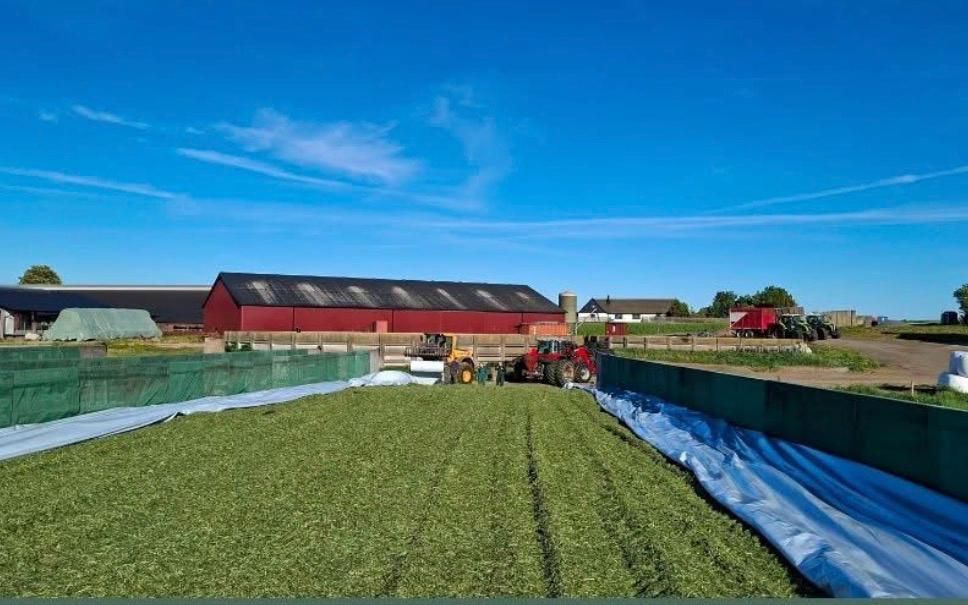
Roll silage in layers (grass up to 20 cm, maize 30-40 cm) with a weight of at least half the hourly intake: 15 tonnes when 30 tonnes come in per hour. Have the crop chopped, avoid wheel ruts and seal the edges tightly. Grass compacts best at 35-45% dry matter (Groeikracht). Harvest forage maize at 32-36% (WUR).
Part of the guideMaking and preserving silage: the complete guide
maximum layer thickness when rolling grass
Groeikracht, VeeteeltGRAS March 2025layer thickness when rolling maize
Silage Safeweight on the pit when 30 tonnes of fresh material come in per hour
Silage SafeIf too much air stays in your silage, heating and mould get a chance and you lose feed value. Only well-compacted silage preserves well, and that starts with rolling.
With poor compaction, more oxygen stays in the material. After opening, that oxygen also gets further in from the silage face. This leads to heating and mould, and indirectly to lower feed value and more feed losses.
Good compaction also helps fermentation. Lactic acid bacteria only get to work once the last oxygen has gone. The whole chain from mowing to feeding is in the guide making and preserving silage.
Put a weight of at least half the hourly intake on the pit. If 30 tonnes of fresh material come in per hour, roll with at least 15 tonnes. Don't use dual wheels: they lower the pressure per square centimetre.
Usually along the walls and in the top layer. That is where most air is, so that is where heating starts first. Roll those spots extra carefully and make sure the cover fits tightly there. "When you see it lying like that, you can also see that the silage is tightly covered, especially at the edges," says Bouwman from Den Andel.
Cover the pit straight away. The longer it stays open, the more air and heat get into the feed. In a field trial with bales by Groeikracht, more than 6% of the dry matter was already lost after 2.5 hours of waiting (Veeteelt, May 2021). After that, keep rainwater out of the pit too, because water along the wall makes the edges extra vulnerable.
When feeding out, you notice whether you compacted well: air doesn't get as far into firm silage. See how Silage Safe covers the pit tightly after rolling on our product information page.
 From the farm
“The great thing is that we can preserve the proteins of the grass much better this way.”Jarne Schuiling, Vries (Netherlands) · read the story
Not sure about your silage?
We are happy to help.
For grass up to 20 cm (Groeikracht), for maize 30 to 40 cm. In a thin layer you press the feed down well right to the bottom.
Wide tyres spread the weight over a larger area. This lowers the pressure per square centimetre, so you compact less well.
Roll the pit evenly and finish the top smooth and slightly rounded, so no water stays on it (WUR). A real rounded profile is what you make when you cover with Silage Safe: then the covers pull the plastic tight and the water runs away through the drainage. Start on this early, not only with the last loads. If you can't get a nice rounded top, drive over it crosswise.
Updated on 5 November 2026.
 Ensiling & compactionQuestions & answers
After you seal the pit, the crop and micro-organisms first use up the last oxygen. Then lactic acid bacteria turn sugars into…
Grass · Maize6 min read Ensiling & compactionGuide
You make silage by storing grass or maize without oxygen, so lactic acid bacteria can ferment it. Work cleanly, ensile at the…
Grass · Maize8 min read Ensiling & compactionTips
During silage fermentation, lactic acid bacteria turn sugars into acids, which makes the pH drop. Wet grass silage is good at a…
Grass · Maize4 min read